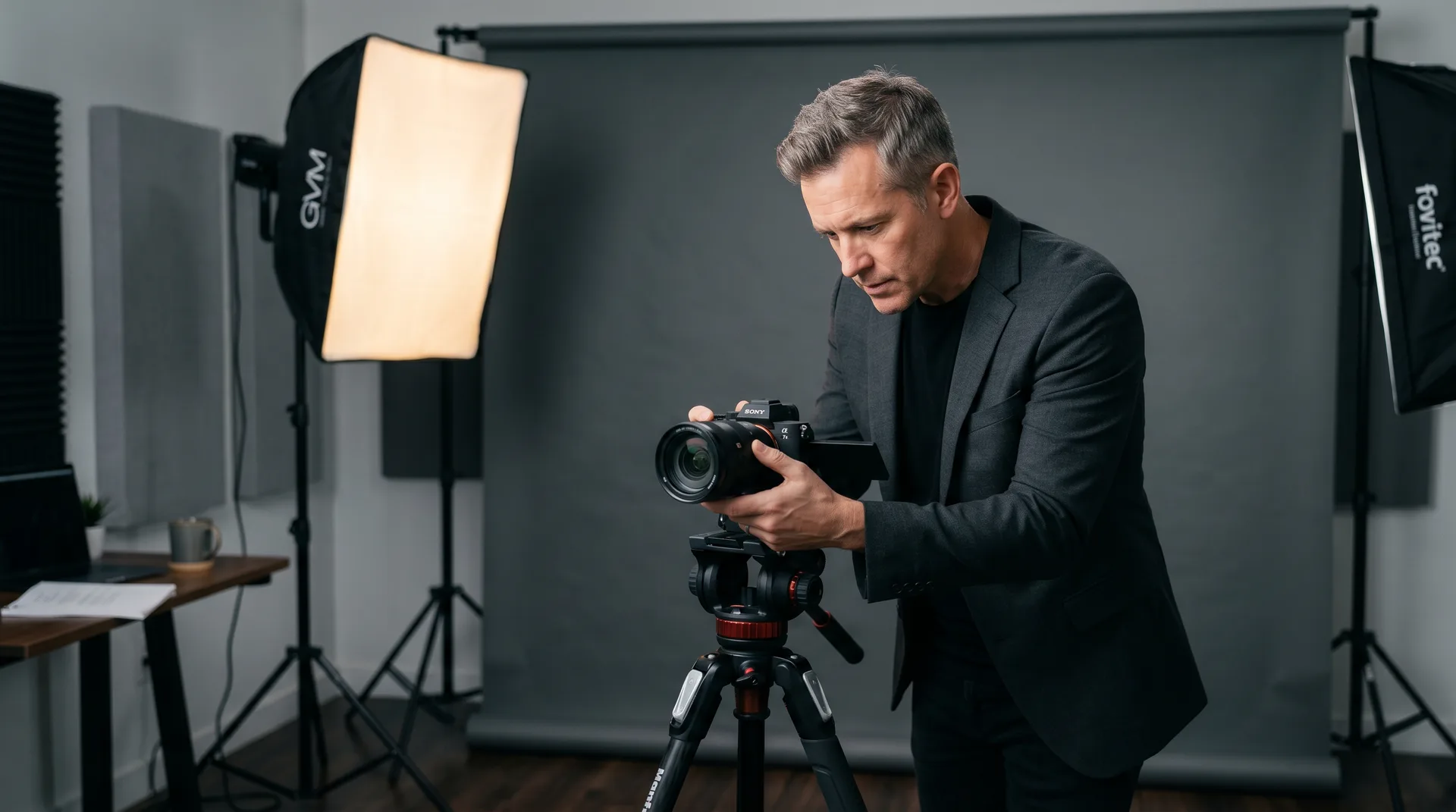
Self-taping for actors has transformed from a pandemic necessity into the industry standard. Whether you're auditioning for film, television, or commercials, your home setup is now your competitive edge. The question isn't whether you need to self-tape - it's whether your self-tapes can compete with actors who have access to professional studios.
The good news? With the right setup and technique, they absolutely can.
Why Drama School Didn't Prepare You for This
Drama school taught you to command a stage, interpret scripts, and find emotional truth in every scene. But it probably didn't teach you about camera framing, audio levels, or how to light yourself like a cinematographer. Now, casting directors expect broadcast-quality self-tapes delivered within 24-48 hours - and they're comparing yours to hundreds of others.
"Mark Janicello's Master Class at UNC-G (University of North Carolina - Greensboro) changed my life!! Until I met him, I was languishing in my apartment with a day job, getting my Masters, and wondering when I was going to be 'discovered!' Mark opened my eyes to the fact that I had the power to make it happen - and that it wasn't going to happen any other way. It's the one piece of information that's not part of the usual university curriculum. Once you have your diploma, after all those hours of practicing - then what???"
- Rhiannon Giddens
That "then what?" now includes mastering self-taping for actors - a skill that can make or break your career before you ever step into a casting room.
The Essential Self-Tape Studio: What You Actually Need
Forget the Instagram-perfect setups with thousands of dollars of gear. Here's what actually makes a difference in self-taping for actors:
Camera Equipment
- Smartphone (iPhone 11 or newer, recent Android flagship) - Modern phones shoot in 4K and are more than sufficient for self-tapes
- Tripod with phone mount - Essential for steady framing at eye level
- Or: Entry-level DSLR/mirrorless camera - Sony a6000 series, Canon M50 if you want to upgrade
Audio Setup
- Lavalier microphone - Rode SmartLav+ or Boya BY-M1 clips to your collar for clear dialogue
- Or: Shotgun microphone - Rode VideoMic GO mounts on camera for better room audio
- Avoid: Built-in phone or camera mics - they pick up too much room echo
Lighting (The Game-Changer)
- Two softbox lights or LED panels - Position at 45-degree angles for flattering, even lighting
- Natural window light + reflector - Budget alternative: film facing a large window during daylight
- Key principle: Your face should be evenly lit with no harsh shadows
Background
- Solid, neutral backdrop - Grey, beige, or soft blue pop-up backgrounds
- Or: Clean wall - Plain painted wall works if it's not distracting
- Avoid: Busy wallpaper, posters, cluttered rooms - casting directors want to see YOU
The Technical Setup: Frame, Focus, and Sound
Having the gear is step one. Knowing how to use it properly is what gets you callbacks.
Camera Positioning
- Eye level - Position camera lens at your eye height when standing or sitting
- Framing - Standard medium shot: top of frame just above your head, bottom at mid-chest
- Reader placement - Position your reader just beside the camera lens so your eyeline is nearly on camera
- Focus - Always test focus before recording
Lighting Technique
- Three-point lighting: Key light at 45° to one side, fill light at 45° opposite, optional backlight
- Check for shadows - Record a test: no harsh shadows on face or background
- Colour temperature - Match your lights (both daylight 5600K or both tungsten 3200K)
"Working with Mark has been both an intense and quite incredible experience. In addition to his personal discipline, communications skills and attention to detail, Mark is blessed with a catalog of diverse talents at his disposal that is nothing less than extraordinary. Mark's talent, tenacity and discipline have brought him success all over the world."
- Animation Studio, Berlin, Germany
How to Compete With Professional Studios (Without Leaving Home)
1. Consistency Is King
Studios deliver consistent quality every time. You can too - by keeping your setup permanent. Don't tear down your lights and backdrop after each tape. Dedicate a corner of a room and leave it ready to shoot.
2. Master Your Editing
- iPhone: iMovie (free, simple, effective)
- Desktop: DaVinci Resolve (free, professional-grade)
- What to edit: Trim slate and scene starts/ends cleanly, adjust audio levels, export in HD (1080p minimum)
- What NOT to edit: Don't add filters, effects, or music unless specifically requested
3. Deliver Like a Pro
- File naming: LastName_FirstName_ProjectName_Role.mp4
- File format: MP4, H.264 codec, 1080p resolution - universally compatible
- Upload platforms: WeTransfer, Dropbox, or Google Drive for large files
- Turnaround time: Aim to deliver within 24 hours unless given more time
"Mark's professionalism and talent, as well as his broad range of experience in both live theatrical and filmed projects, impresses me. He has performed in 40+ countries - in plays, musicals, cabaret, operetta, modern opera, grand opera, television, commercials and movies. His vocal range is extraordinary, encompassing a voice suitable for a wide range of styles from grand opera to Elvis Presley. Mark Janicello is a versatile, talented and serious artist. I have the upmost respect for him. His innumerable talents as performer, writer and businessman set him apart."
- Vincent Paterson, Director and Choreographer (Michael Jackson, Madonna)
Common Self-Tape Mistakes (And How to Fix Them)
Mistake #1: Filming in Vertical (Portrait) Mode
Fix: Always film horizontally (landscape). Television and film are horizontal mediums.
Mistake #2: Poor Framing
Fix: Too much headroom looks amateurish. Too tight feels claustrophobic. Aim for a finger's width of space above your head.
Mistake #3: Looking Directly at Camera (Unless Asked)
Fix: Your eyeline should be just off-camera, as if speaking to another person beside the lens. Only look directly at camera if the script calls for it.
Mistake #4: Over-Apologizing or Explaining
Fix: Don't slate with 'Sorry, this is my first self-tape.' Just state your name, location, and jump into the scene. Confidence reads on camera.
Mistake #5: Ignoring the Slate
Fix: Your slate is your first impression. Stand in the same spot as your scene, state your name clearly, and smile naturally.
Mistake #6: Sending Huge File Sizes
Fix: Compress files if over 500MB. Use Handbrake (free) to reduce file size without losing quality.
The Self-Tape Workflow: From Script to Submit
Here's a proven process for turning around professional self-tapes quickly:
Receive sides and breakdown (character description, scene context)
Analyze the script (15-30 minutes): Who is your character? What do they want? What's the tone?
Rehearse off-camera (30-60 minutes): Get comfortable with lines and choices before pressing record
Set up and test (10 minutes): Check frame, focus, lighting, audio levels
Record slate: Name, location/representation, height (if requested)
Record scene takes: Do 2-4 full takes with different choices. Don't stop if you flub a word - keep going like a pro.
Review footage: Watch back with a critical eye. Are your choices clear? Is audio/video quality good?
Select best take: Pick the one where you're most present and your choices are strongest
Edit and export: Trim slate + scene cleanly, export as MP4
Upload and submit: Name file correctly, upload to their preferred platform, send link
Work With a Pro
Mark Janicello is an award-winning performer and coach with 35+ years of international experience. Learn from the best - or book Mark for your next project.
Book Mark NowInvesting Wisely: When to Upgrade Your Setup
Start simple. As you book more work, reinvest earnings into better gear. Here's a smart upgrade path:
| Stage | Recommended Setup |
|---|---|
| Starting out | Phone + tripod + lav mic + DIY lighting |
| First few bookings | Add LED panel lights + pop-up backdrop |
| Regular auditions | Upgrade to entry DSLR + shotgun mic |
| Working actor | Professional lighting kit + better lens |
What Casting Directors Notice (That You Might Miss)
- Background distractions: Unmade beds, laundry, posters - anything that pulls focus from your performance
- Inconsistent framing between slate and scene: If you move positions, they notice
- Eye line shifts: Glancing at a script or screen mid-scene breaks the illusion
- Audio quality: Echo-y rooms or distant mics are immediate red flags
- Confidence: Do you look comfortable on camera, or apologetic?
Frequently Asked Questions
Can I really compete with professional studios using just my phone?
Absolutely. Modern smartphones shoot in 4K with excellent image quality. Paired with proper lighting and audio, phone-shot self-tapes are indistinguishable from studio quality. Focus on technique, not gear.
What if I don't have space for a permanent setup?
Create a portable kit: phone tripod, clip-on lights, foldable backdrop. Set up in front of a neutral wall or clean corner. It takes 10 minutes to arrange and can be packed away when not in use.
How do I know if my self-tape quality is good enough?
Record a practice scene, then watch it on a laptop or TV (not just your phone). Ask: Can I clearly see facial expressions? Can I hear every word? Is the framing professional? If yes to all three, you're ready.
Should I show multiple takes in one self-tape?
Only if requested. Most casting directors want your single best take. Showing multiple versions suggests you're unsure of your choices. Be decisive - pick your strongest and submit that.
What's the biggest mistake actors make with self-taping?
Rushing. Take time to understand the character, rehearse properly, and test your technical setup. A self-tape submitted 12 hours later with strong choices beats one submitted in 2 hours with weak ones.
Do I need to memorize lines for self-tapes?
Not necessarily, but you should be extremely comfortable with them. If you're glancing at sides frequently, it shows. Ideally, know lines well enough that you're looking at your reader 90% of the time.

Mark Janicello
Award-winning performer, playwright, and voiceover artist with 35+ years of international experience across 53 countries. Author of "Naked in the Spotlight."